
Begin a Oneida County Property Records Search
Turn a street address into a municipality, SWIS code, and tax-map identifier with the Oneida County Tax Parcel Viewer or the assessment roll. Keep every dot, hyphen, and leading zero. Identifiers vary by map project here. A shortened number can point to the wrong parcel.
That parcel key then links the roll, the tax account, auction lists, and the map. To find the latest deed, search the roll's owner name in IQS and compare the deed's legal description. This sequence identifies official records well. It does not replace a title examination, appraisal, or boundary survey.
- Locate the situs address and copy the full tax-map number, municipality and roll year.
- Read the current-owner, mailing-address, class, land, total, exemption and taxable fields.
- Search the named owner in IQS and compare the newest deed's legal description.
- Check the tax service, recorded maps and city permit files for the question at hand.
- Use the Clerk's counter, mail form or FOIL when the digital record stops.
Custodians of Oneida County Property Records
The County Clerk records deeds, mortgages, liens, maps, and related instruments. Local assessors build the assessments. County Real Property Services maintains the roll and tax-map infrastructure. Finance handles county tax extension, delinquent accounts, and tax foreclosure. City offices add permits, zoning, and planning files. None of them replaces the county deed index.
Real Property Services
800 Park Avenue
Utica, NY 13501
315-798-5750
Oneida County Finance
800 Park Avenue
Utica, NY 13501
315-798-5753
Oneida County Deeds in IQS
SearchIQS offers a guest path into the County Clerk index. Search Party 1 and Party 2. Choose DEED as the document description. Narrow by date only after testing the name broadly. The help material supports partial names and a wildcard. A town filter can hide a valid result, though. Not every indexed instrument carries a town value.
The Clerk's coverage legend draws an important line. Deed index data begins in 1963; deed images begin in 1974. A 1968 hit may give a book and page with no online image. Earlier work stays in archival books and office requests. Do not assume the chain begins with the first web result. The official IQS entry screen displays the guest and account routes for this search.
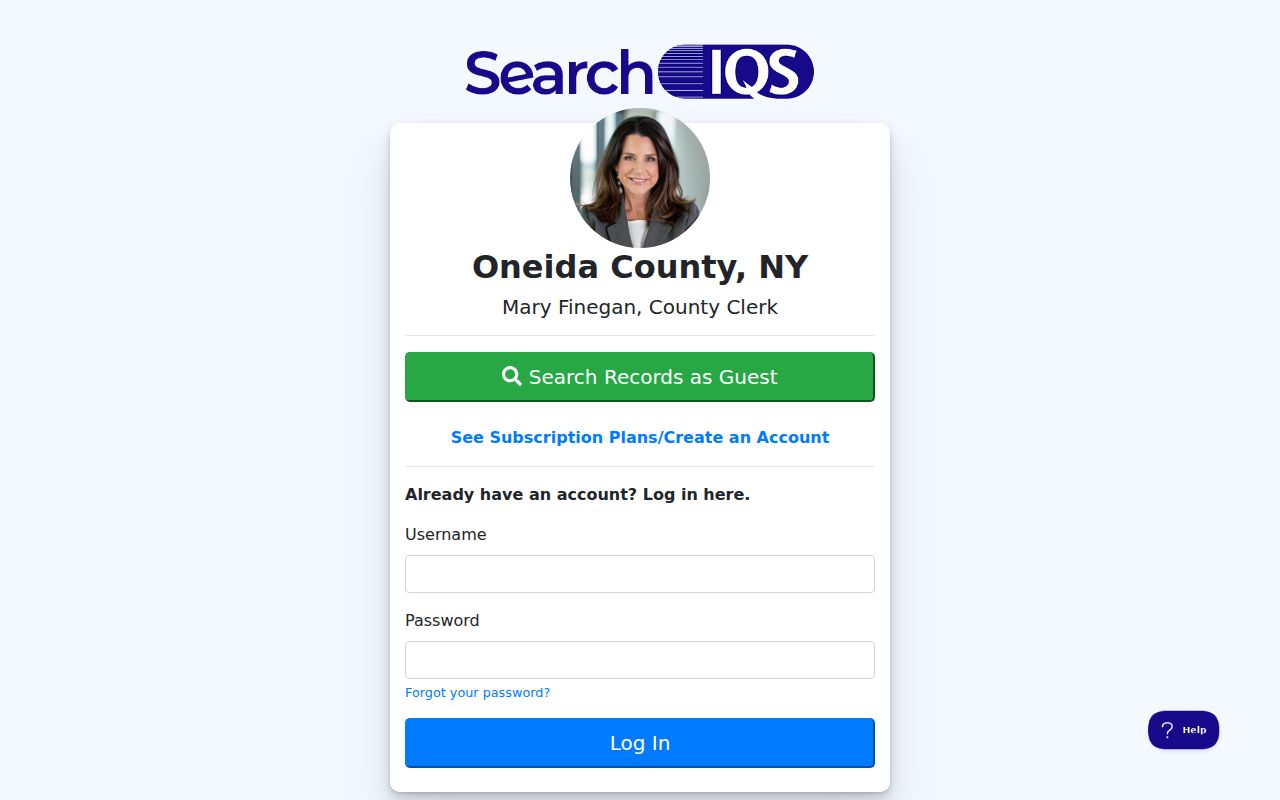
The IQS landing page is only the starting point. The deed image and its legal description supply the document-level confirmation.
What Oneida County Property Records Include
Each record set answers a narrow question. The deed shows a recorded conveyance. The annual roll supplies assessment fields, while the tax account reports billed or delinquent charges within its stated coverage. The plat and GIS help reconcile geography, and city files document approved or proposed work.
| Record Type | What It Documents | Kept By | Access |
|---|---|---|---|
| Deeds | Transfers, parties, consideration and legal description | County Clerk | IQS, office and copies |
| Mortgages and liens | Recorded claims, financing and releases | County Clerk | Category-specific index coverage |
| Assessment and tax | Owner field, class, values, exemptions and charges | Local assessors and Finance | Roll archive and tax search |
| Plats and parcels | Recorded lots and tax-map reference lines | County Clerk and RPTS | Viewer, map index and office |
| Permits and zoning | Applications, approvals, inspections and land-use review | Utica, Rome or Sherrill | City pages, agendas or request |
A chain-of-title question belongs in the Oneida County deed records. A billed amount or an exemption question belongs with the local assessor and Finance. Never merge a map label, a mailing address, and a legal description as though they were the same field.
Assessment Rolls Preserve a Dated Snapshot
The final assessment-roll archive is organized by municipality and year. A single roll can show the tax-map parcel number, property location, owner's name and mailing address, school district, class, land value, total assessment, exemptions, and taxable value. Treat it as a dated assessment source, not a live title feed.
New York's standard calendar sets March 1 as taxable status date, followed by the tentative roll, the grievance period, and the final roll. A deed recorded after taxable status can appear in IQS before the owner field changes on a public roll. Always state the roll year when naming the owner. The county archive page displays the municipal roll route.
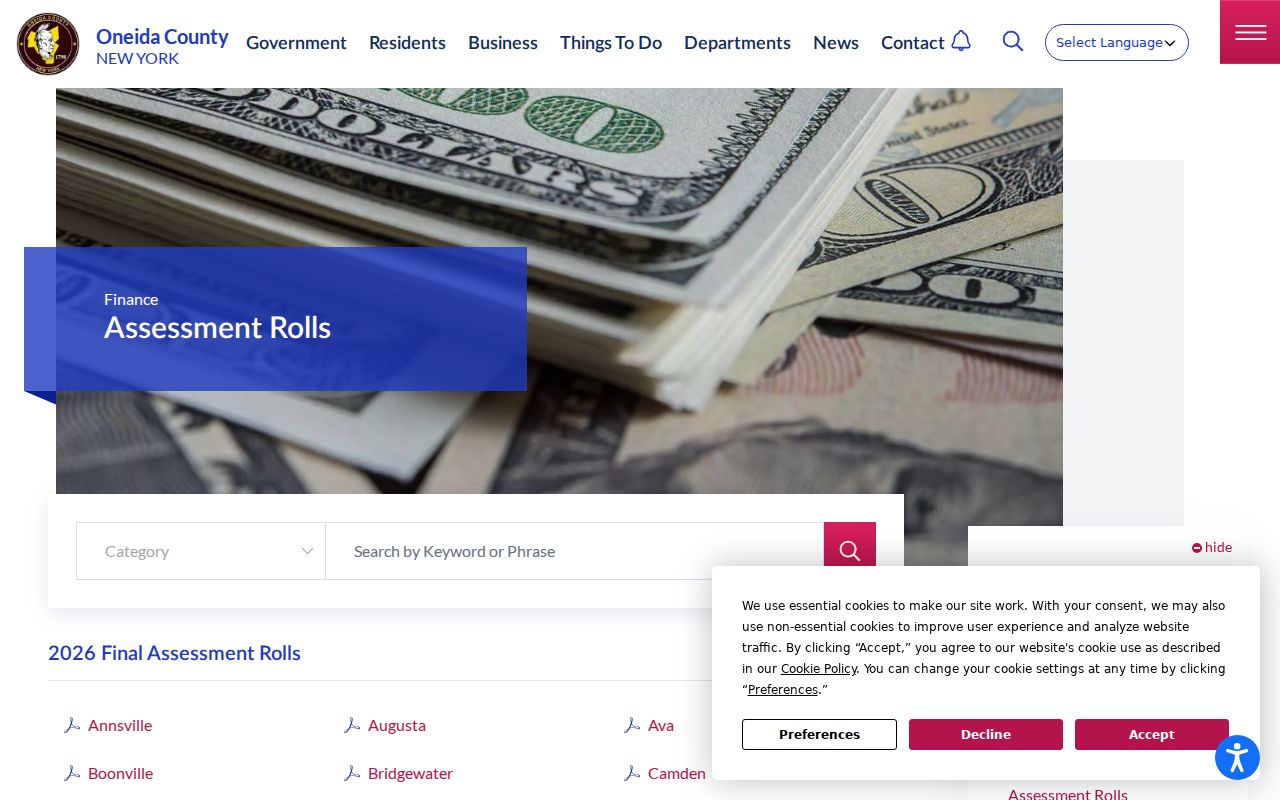
The archive view helps researchers pick the right municipality before opening a large annual roll.
Tax Results Need a Coverage Date
The county tax service accepts a tax-map number, owner name, or street address. Its notice states that current 2026 and prior-year 2025 delinquent data are visible. Older charges are in transition. So a blank result proves nothing about older amounts. Confirm the date and account with Finance.
The service also shows an older December 1, 2025 deadline on the 2026 page. Treat that as stale text and ask Finance for a current payoff or deadline. Tax-roll archives, the live payment screen, and foreclosure files remain distinct sources.
Oneida County Parcel Layers and Map Limits
The county launched its first online tax parcel viewer in 2021. It places tax parcels over imagery. It also offers layers for floodplains, wetlands, contours, soils, school districts, and sanitary districts. Those layers help with due diligence. A tax polygon still does not establish a surveyed boundary.
The 2023 mapping project documented 1,284 sheets across city, town, and village projects. It also covered an ArcGIS Pro migration and an active split-and-merge workload. That history explains a common mismatch. A new deed, an older sheet, and the live polygon may temporarily differ. Use the recorded subdivision map and a survey when the line itself matters. The county parcel viewer is the official map entry point.
The map application is official; check individual layers and their dates inside the viewer itself.
Recorded Plats and Changing Parcel Numbers
Start with the maps themselves. A subdivision plat is a recorded map carrying survey and approval certificates. A tax map serves as an assessment reference for the parcel number on the roll. Oneida County's filing instructions ask for original mylar, paper copies, and planning, health, and tax certifications. A $10 filing fee is stated. One wrinkle matters here. The current GIS can reflect a later split, merger, or consolidation. It is filed under a new parcel identifier.
When a deed describes a subdivision lot, pull the recorded map. Compare its lot labels against the current roll. Utica Engineering and Rome Planning files often explain a consolidation or lot-line adjustment. Keep the old book-and-page references alongside the new tax-map key so the deed records stay traceable.
Daily Conveyance Notices and Fraud Alert
Conveyance notices now arrive daily. The County Clerk reports that delivery shifted from monthly to daily in 2023, so a recorded deed or mortgage surfaces far sooner than it once did. For active monitoring, the separate IQS Fraud Alert tracks up to three names and sends email or text notice whenever a matching document is recorded. Owners can add a trust or related name when appropriate.
An alert is only notice, though. It is not a finding that a filing is valid or fraudulent. Open the instrument, compare signatures and the legal description, and contact the Clerk or counsel promptly if the document is unfamiliar.
Older Oneida County Land Records
The paper trail still lives at the County Clerk. Public computers and archival books are open during search hours. Office guidance permits free viewing. Printing from a public computer costs $0.65 per page with a $1.30 minimum. A mail search runs $5 per name for each two-year period. Frame the request tightly. Name the record type, party variants, and a narrow date range to keep the search manageable.
The Clerk's genealogy page extends the reach further. It points to deeds, mortgages, Utica and Rome directories, and local repositories. Newspapers from 1841 through 1879 are included too. A directory can connect an old street occupant to a deed search name. It cannot prove ownership on its own, so the recorder's deed records remain the anchor.
City Files Add the Local Property Story
Utica, Rome, and Sherrill are Oneida County's three incorporated cities. The county systems still hold the deeds, tax maps, and core roll data. City sources add the local story. Utica's permit form uses CTM book, map, block, lot, and ward fields. These fields tie a permit to the parcel number. Rome publishes planning applications and agendas. Sherrill's 2025 zoning code supplies district and process rules. But the city publishes no public parcel-result portal.
Watch the geography closely. Do not confuse the City of Rome with the surrounding Town of Rome. Do not mistake a postal city label for a municipal boundary. The SWIS code, municipality, and county parcel geometry control the current record.
FOIL Fills a Oneida County Access Gap
New York FOIL covers the gaps. It applies when a government record is not already offered through a portal or routine copy process. The request must reasonably describe the record sought. Timing is set by statute. The agency generally has five business days to grant, deny, or acknowledge the request. It must also provide an approximate determination date. A denial may be appealed within 30 days.
Direct the request to the office that created the record. A city permit file goes to that city. A deed copy goes to the County Clerk. A Finance account question goes to Finance. A focused request wins. Address, parcel number, date range, and record type serve better than a demand for every document about a property.
Limits of Oneida County Property Records
Official Oneida County property records have honest limits. They can show the owner of record on a dated roll, a recorded transfer, assessed and taxable values, filed liens, a tax status, and reference geography. What they cannot do is equally clear. They do not prove who occupies a building, guarantee marketable title, establish a surveyed boundary, or state what a buyer would pay. A missing online result may simply reflect an index cutoff, spelling variant, restricted file, or undigitized volume rather than a true gap in the deed records.
Lawful use. Use Oneida County property records for legitimate property research and civic review. They are not a title search, survey or permission to target or harass a person.