
How to Find Who Owns a Oneida County Property
Treat every owner listing as a snapshot with a date attached. Check the municipality first. Then check the tax-map identifier. Also weigh how far the online coverage actually reaches before drawing conclusions. A dynamic portal may sit outside the online archive. The same is true of an older volume. In those cases, the county office itself is the route. Lay the assessment roll beside the most recent recorded instrument and see whether they agree.
- Record the exact address, municipality, tax-map number, source date and document reference before moving to the next official source.
- Record the exact address, municipality, tax-map number, source date and document reference before moving to the next official source.
- Record the exact address, municipality, tax-map number, source date and document reference before moving to the next official source.
- Record the exact address, municipality, tax-map number, source date and document reference before moving to the next official source.
Where Oneida County Owner Information Comes From
Owner information in Oneida County flows from the assessment roll. It also comes from the recorded deed index and the tax map. Each has its own date and its own gaps. The roll names the owner for that roll year. The deed shows who took title and when. Where online access stops, the county office fills in the rest.
| Source | Owner Info It Gives | Access |
|---|---|---|
| Assessor / tax roll | Official county record field, subject to the source date and stated coverage | Official county record field, subject to the source date and stated coverage |
| Recorder deed index | Official county record field, subject to the source date and stated coverage | Official county record field, subject to the source date and stated coverage |
| Secretary of State | Official county record field, subject to the source date and stated coverage | Official county record field, subject to the source date and stated coverage |
| GIS parcel viewer | Official county record field, subject to the source date and stated coverage | Official county record field, subject to the source date and stated coverage |
No single file holds the owner story. The roll gives one version and the deed records give another. Match the municipality, the tax-map identifier, and the dates. Then weigh the newer instrument more heavily. For anything a portal will not reach, the office counter is still the answer.
Read the Exact Oneida County Owner Field
The annual roll prints the owner in a field labeled CURRENT OWNERS NAME. A second field, CURRENT OWNERS ADDRESS, appears separately. The first field names the assessment-roll owner for that roll year. The second tells you where notices go. Neither one proves a person lives at the property itself.
Copy the tax-map number and the property location. Also copy the exact owner spelling, the municipality, and the roll year. Then run that owner through IQS as a deed grantee. The latest deed carries the legal description, the recording date, and the instrument reference. Together these confirm the recorded transfer far better than the roll alone.
Trusts, Estates and Companies in Oneida Records
An LLC can be the named grantee and the roll owner. So can a trust, an estate, or a fiduciary. Search the exact entity name instead of swapping in an individual. New York's Department of State entity search returns legal status, organization date, and a service address. That service address is rarely the property address.
Estates can pull you into Surrogate's Court records, probate instruments, or a later deed. Oneida County also recognizes Transfer on Death Deeds under RPL section 424. Those instruments are effective from July 19, 2024. When vesting language gets murky, legal advice is the right move.
Why the Roll May Name the Prior Owner
New York sets the taxable-status date at March 1. A deed recorded after that date lands in the County Clerk index, yet the annual assessment snapshot may still carry the prior owner. The county publishes no fixed average lag between a recorded deed and the updated roll.
The strongest answer names the owner shown on the cited roll and notes whether the latest accessible deed agrees. Do not stretch that result into a claim about occupancy or guaranteed title. Safety programs can also substitute addresses for qualifying participants.
Official Oneida County Ownership Entry Points
The Real Property Services page directs a searcher to official assessment and parcel resources.
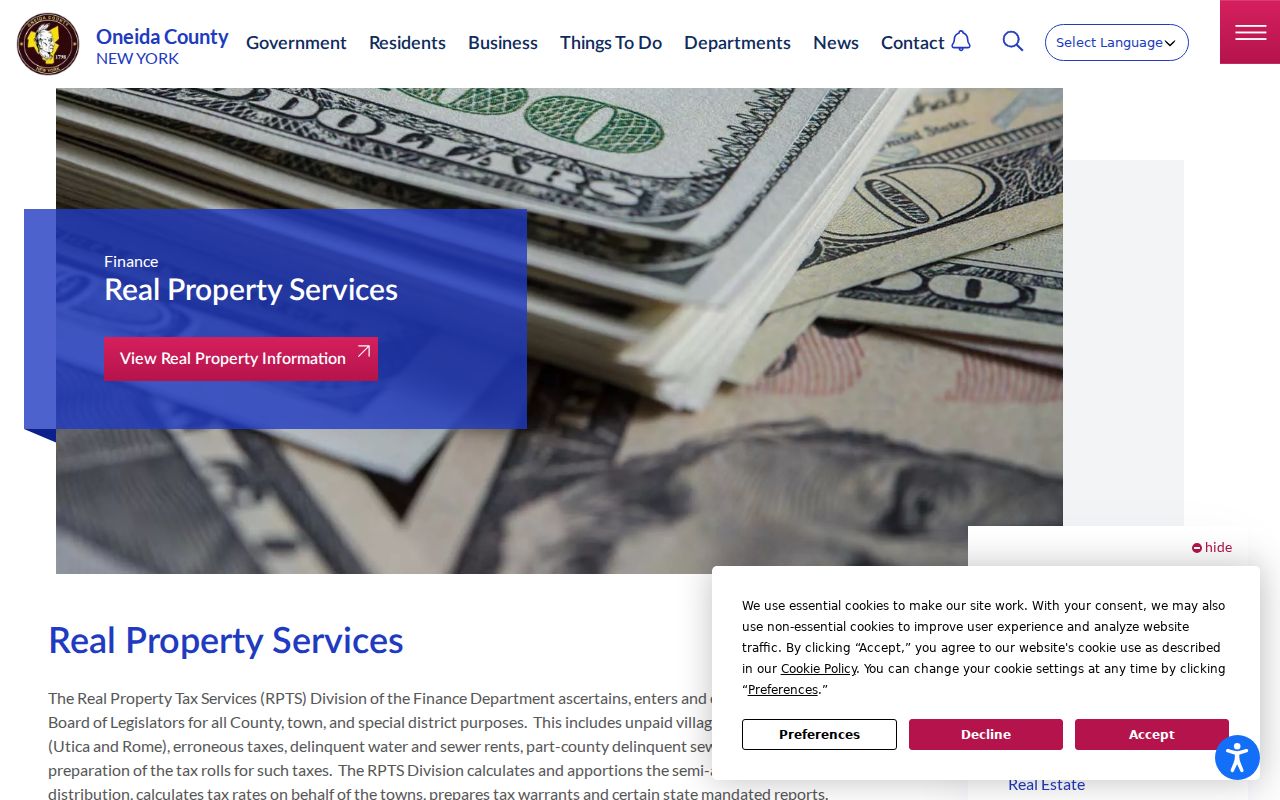
The county page is the authoritative starting route. Even so, the dated roll and the newest deed remain the two records worth comparing.
What "Who Owns This Property" Cannot Tell You
An owner name alone settles less than people hope. It will not confirm occupancy, title condition, or legal control of the parcel. Read each record with its source date, its municipality, and its tax-map identifier in mind. Where online coverage ends, the office route picks up. The latest recorded instrument outweighs the roll when the two disagree.
Lawful use. Use public records for legitimate property research. Do not use owner data to target, threaten or harass anyone.