
Oneida County Deed Records and What They Show
Reading Oneida County deed records works best when you keep four details in hand. These are the source date, the municipality, the tax-map identifier, and whatever limits the online coverage has. Older volumes sit in books, not databases. Set the assessment roll beside the latest recorded instrument. See whether the two agree on ownership. When a dynamic portal will not reach a record, the office route still can.
| Deed Type | What It Does | Common Use |
|---|---|---|
| Warranty deed | Official county record field, subject to the source date and stated coverage | Official county record field, subject to the source date and stated coverage |
| Quitclaim deed | Official county record field, subject to the source date and stated coverage | Official county record field, subject to the source date and stated coverage |
| Grant / special warranty | Official county record field, subject to the source date and stated coverage | Official county record field, subject to the source date and stated coverage |
| Trustee / executor deed | Official county record field, subject to the source date and stated coverage | Official county record field, subject to the source date and stated coverage |
| Tax deed | Official county record field, subject to the source date and stated coverage | Official county record field, subject to the source date and stated coverage |
Every Oneida County deed entry deserves a quick context check. Note the source date, the municipality, and the tax-map identifier before you rely on it. Online coverage stops short of the older volumes. The assessment roll tells you who is listed today. The newest recorded instrument tells you what actually conveyed. Compare the two. Turn to the office when the portal cannot reach back far enough. That keeps the record trail intact.
The Oneida County Grantor-Grantee Index
The grantor-grantee index is the backbone of Oneida County deed research. Each entry carries a source date, a municipality, and a tax-map identifier. Weigh all three before trusting a match. Remember that online coverage has limits. Line up the assessment roll against the most recent recorded instrument. When a dynamic portal or an old volume sits out of reach online, the office route finishes the job.
- Record the exact address, municipality, tax-map number, source date and document reference before moving to the next official source.
- Record the exact address, municipality, tax-map number, source date and document reference before moving to the next official source.
- Record the exact address, municipality, tax-map number, source date and document reference before moving to the next official source.
- Record the exact address, municipality, tax-map number, source date and document reference before moving to the next official source.
- Grantor
- The grantor who transfers the recorded interest.
- Grantee
- The grantee who receives the recorded interest.
- Chain of title
- The chain linking successive recorded conveyances.
- Book/Page vs Instrument #
- The book and page or instrument identifier used to retrieve it.
Oneida County Deed Index and Image Cutoffs
The County Clerk's Public Record Legend draws a clear line between index data and images. Deed index data starts in 1963. Deed images begin in 1974. Mortgages follow the same pattern. Mortgage data runs from 1963. Mortgage images date to 1973, and map images run online from October 2004. Hitting a cutoff does not end the chain of records. It only means you change access channels.
Before 1963, the work moves to archival deed books, office computers, a mail search, and local repositories. The Clerk's genealogy page points to older deeds and mortgages. It also lists Utica and Rome directories and newspapers from 1841 through 1879. A directory can supply a search name or an old address. It never proves title.
Fields That Tie a Deed to the Parcel
Capture more than the names when you pull a deed. Save the grantor, the grantee, the recording date, the document type, book and page, instrument number, municipality, consideration, and the full legal description. Then compare the subdivision lot, metes-and-bounds calls, or prior-instrument recitals against the roll and the plat or GIS map. Oneida County records warranty, quitclaim, bargain-and-sale, and referee deeds. A shared surname proves little on its own.
Keep the categories straight. A mortgage or lien is an encumbrance, not a conveyance. And a recorded document only shows that the Clerk accepted it for filing; it is not a legal opinion that the signer held marketable title.
Oneida County Copies, Counter Access and Alerts
The official deed-copy route runs through IQS as a guest. Enter the last name and then the first name in Party 1. Select DEED, and choose the name, date, and township. Open View, then print or download the PDF or images. Copies are generally listed at $0.65 per page, with certification and preparation charged separately.
For monitoring, the IQS Fraud Alert accepts up to three names. It sends notice by email or text. The Clerk also reports that conveyance notices shifted from monthly delivery in 2023 to daily. An alert is a prompt to inspect a filing. It is not a determination that fraud occurred.
See the Oneida County Deed Copy Route
The County Clerk's official deed-copy instructions walk through each step that turns an IQS result into a printable document.
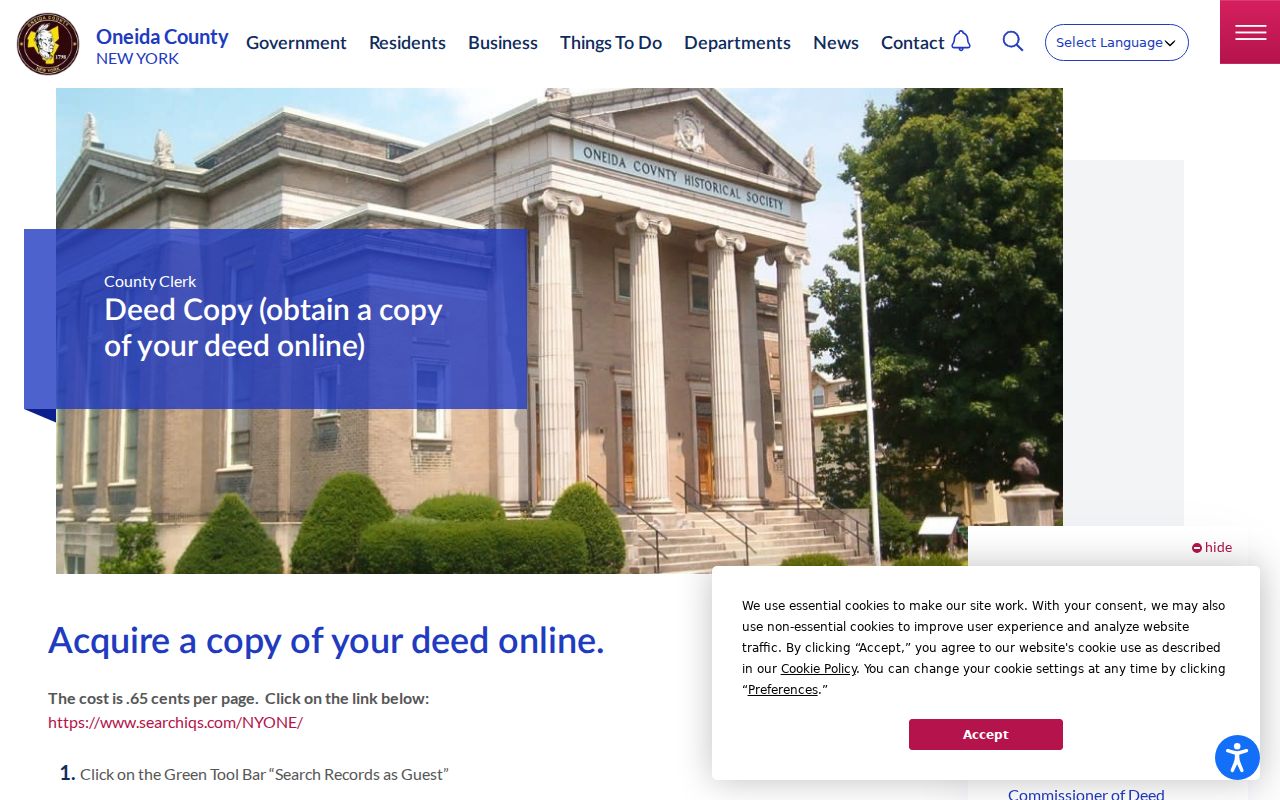
The Clerk's instructions also stress the details that decide the search: choosing the correct party, date, and township before opening the image.
Getting a Copy of a Oneida County Deed
Ordering a copy of a Oneida County deed starts with the same four details: source date, municipality, tax-map identifier, and online coverage limits. Put the assessment roll next to the latest recorded instrument to confirm the parcel and owner of record. When the portal cannot reach a dynamic result or an older volume, the office route handles it directly.
Record limit. Confirm dates, deadlines and legal effect with the office that keeps the original record.